
Article written by: Emilie St-Martin, RD — Dietitian / Nutritionist
When choosing baby-led weaning (BLW), it is important to adapt the textures and sizes of the foods offered to baby according to their age and development.
Here is a short guide to help you serve foods adapted to your baby!
6 months: large, soft pieces
At the beginning of weaning, baby has not yet developed the pincer grasp (the ability to pick up a small object between the thumb and index finger). Instead, they use their whole hand to grab food. Therefore, we prefer large, soft pieces that are easy to grasp. These pieces must stick out from their little hand so they can hold them and bring them to their mouth themselves.
How do you know if the texture is adapted to their age?
Food offered at 6 months should be easily mashable between your fingers (or between your tongue and palate).
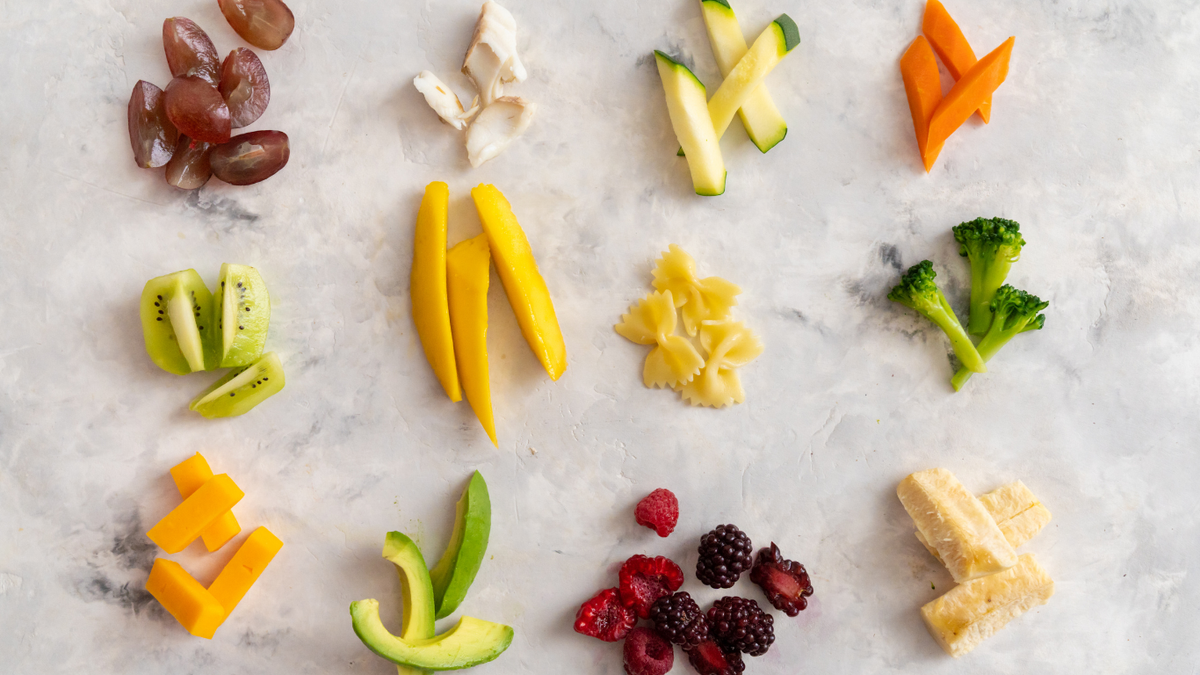
Examples of foods adapted for 6 months:
Very ripe fruits (banana, avocado, pear, peach, citrus segments)
-
Vegetables that are well-steamed or boiled
-
Fish, very tender meat, or tofu
-
Well-cooked pasta
And what about purées?

Even if you choose BLW, purées can absolutely be part of the menu.
BLW does not mean "zero purée"! Baby can eat yogurt, fruit compotes, soups, mashed foods (e.g., legumes, fruits/vegetables), or any other purée.
These foods can be offered on a spoon (pre-loaded and left for baby), as a dip for their pieces, or spread on a food that serves as a carrier (e.g., crackers, toast, plain rice cake, etc.)
Bread

Speaking of bread, you should know that it is entirely possible to offer bread from 6 months, provided it is toasted!
Untoasted bread can form a sticky ball in the mouth, which increases the risk of choking. Once toasted, it becomes safe and can then be served to baby with a thin layer of nut butter, a purée, or a spread.
Around 9 months: introduction of smaller pieces
Around 9 months, or when they start using their fingers to pick up food rather than their palm, baby is ready to incorporate small, tender pieces (about the size of a die).
Texture remains important: food must still be easy to mash, but it is possible to offer food that is "tenderer" and less "soft."
Safe examples:
-
Vegetables cooked until tender (carrots, broccoli, sweet potatoes, etc.)
-
Very ripe fruits cut into small pieces
-
Eggs, tofu, lentils
-
Tender meat, cut up
-
Legumes very roughly mashed with a fork
Around 12 months:
Key takeaways
The progression of textures is not based on age alone, but primarily on baby’s motor development.
-
At 6 months, start with large, soft pieces
-
Around 9 months, advance to smaller, tender pieces
-
At 12 months, baby shares the family menu
And above all: every baby progresses at their own pace. The important thing is to offer a safe, supervised, and pressure-free environment to allow them to explore food.
References:
Institut national de santé publique du Québec (INSPQ). Baby-led weaning. Available at: https://www.inspq.qc.ca/mieux-vivre/alimentation/aliments/diversification-alimentaire-menee-par-enfant. Accessed February 18, 2026.
Naître et grandir. Self-feeding (baby-led weaning). Available at: https://naitreetgrandir.com/fr/etape/0_12_mois/alimentation/alimentation-autonome/. Accessed February 18, 2026.
Brown A, Jones SW. A Baby-Led Approach to Eating Solids and Risk of Choking. Pediatrics. 2016;138(4):e20160772.
Institut national de santé publique du Québec (INSPQ). Choking hazards – Feeding children. Available at: https://www.inspq.qc.ca/mieux-vivre/enfant/alimentation/aliments/risques-etouffement. Accessed February 18, 2026.
Health Canada. Nutrition for healthy term infants: Recommendations from six to 24 months. Available at: https://www.canada.ca/en/health-canada/services/canada-food-guide/resources/nutrition-infant-term-healthy/nutrition-infant-term-healthy-recommendations-6-24-months.html. Accessed February 18, 2026.
Partager:
Baby-led weaning (BLW): what to know before starting